ROB 101 Computational Linear Algebra: Mathematics at the Scale of Life
ROB 101 | Computational Linear Algebra
Where linear algebra becomes computation, perception, and intelligent systems.
A first-year Michigan Robotics course with serious theoretical preparation in linear algebra, numerical methods, optimization, and computation, taught through robotics, data, and AI-scale applications.
Start engineering mathematics with theory you can use
ROB 101 puts linear algebra and programming together from the beginning without reducing the mathematics to software training. Students build a working command of systems of equations, linear independence, span, bases, rank, the rank-nullity theorem, eigenvalues, eigenvectors, factorization, least squares, orthogonality, null spaces, root finding, and optimization.
The computational setting lets the course ask more of students, not less. Small hand calculations establish definitions and proofs; Julia assignments then make the same ideas operate on hundreds or thousands of variables. Matrices become both mathematical objects and engineering tools for perception, regression, classification, and control.
Who should take it?
First-year students interested in robotics, AI, data, computer vision, machine learning, engineering, or applied mathematics.
Fall 2026 format
The remote section will be closed in Fall 2026 after students overused AI. The course is expected to reopen a remote pathway in a future semester once assessment uses the North Campus computer-based testing center powered by PrairieLearn.
Why ROB 101 instead of waiting?
Linear algebra is central to robotics, machine learning, computer vision, and data. ROB 101 lets students meet that language early, with both theory and applications attached.
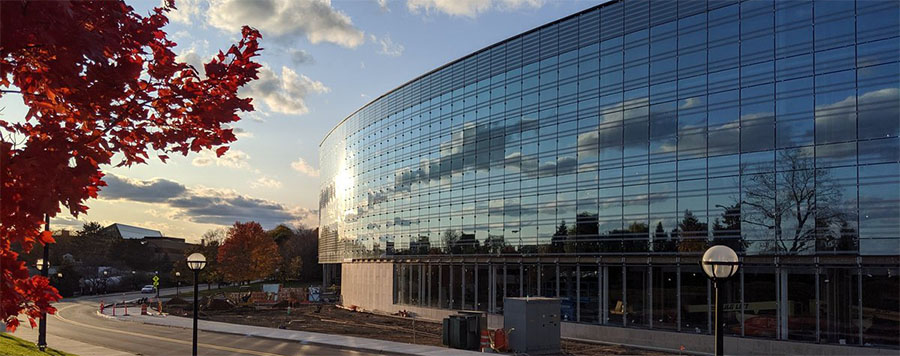
ROB 101 grew out of Michigan Robotics' effort to move students into meaningful technical work earlier.
Theoretical preparation, computationally grounded
The textbook is explicit about the preparation ROB 101 provides. Students learn the mathematics of linear systems and vector spaces alongside the algorithms that make those ideas reliable at scale.
Linear systems
From Ax = b to factorization
Students study systems of equations, determinants, triangular systems, forward and back substitution, matrix multiplication, permutation matrices, inverses, and LU factorization for solving linear equations.
The course emphasizes what happens when systems have one solution, no solution, or infinitely many solutions, and how structure makes large systems computable.
Vector spaces
Geometry, subspaces, and orthogonality
Students learn linear combinations, span, linear independence, bases, coordinates, dimension, eigenvalues, eigenvectors, rank, nullity, the rank-nullity theorem, column spaces, null spaces, dot products, orthonormal vectors, Gram-Schmidt, and QR factorization.
This is the theoretical core behind regression, projection, perception, and many later topics in machine learning and control.
Numerical methods
Approximation, root finding, and optimization
Students use least-squares regression, bisection, numerical derivatives, Newton and Newton-Raphson methods, gradient descent, Hessians, and introductory quadratic programming and max-margin classification.
Optimization is treated as a mathematical idea and as a practical engine for modern engineering systems.
Projects at the scale of life
The projects are where preparation turns into engineering judgment. They are not a substitute for theory; they are the place where the theory has to work.
LiDAR mapping
Students process point-cloud measurements, coordinate frames, and matrix-vector operations to build a map a robot can use for navigation.
Regression and machine learning
Students fit models to a large NOAA precipitation dataset using least squares and radial basis functions.
Segway control
Students connect matrices, optimization, ODEs, and discrete-time models to balancing and driving a mobile robot.
Camera and LiDAR models
Students encounter pinhole cameras, homogeneous coordinates, calibration, and projections between sensors.
The organizing ideas
ROB 101 becomes memorable because the same mathematical moves keep reappearing in different settings.
Representation
Vectors and matrices give engineers a compact language for equations, images, point clouds, signals, and robot states.
Solvability
Systems of equations can have one solution, no solution, or many. Students learn how structure determines what is possible.
Factorization
LU and QR reveal the structure inside matrices, turning hard systems into organized sequences of simpler problems.
Approximation
Least squares, regression, projection, and classification let students make principled models when exact answers are not available.
The ROB 101 precedent matters
ROB 101 was created in 2020 in anticipation of the Michigan Robotics undergraduate major launching in 2022. It began as a 41-student Fall 2020 pilot and now enrolls roughly 150 to 200 students in both fall and winter terms.
Students reach advanced courses earlier
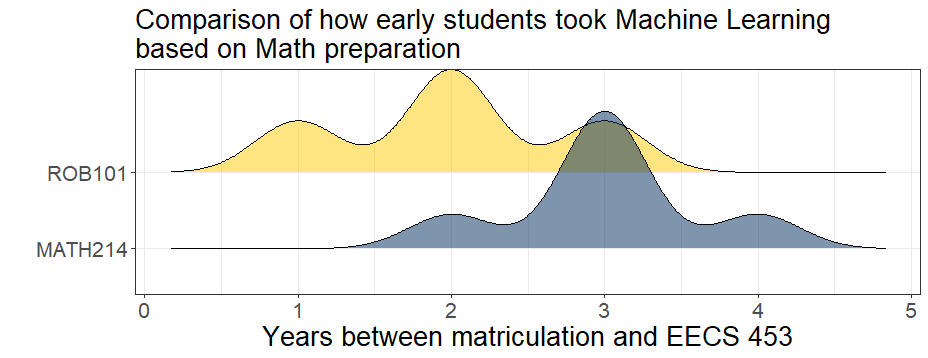
ROB 101 students reached machine-learning coursework about two semesters earlier than students who took the traditional MATH 214 route.
Downstream outcomes are comparable
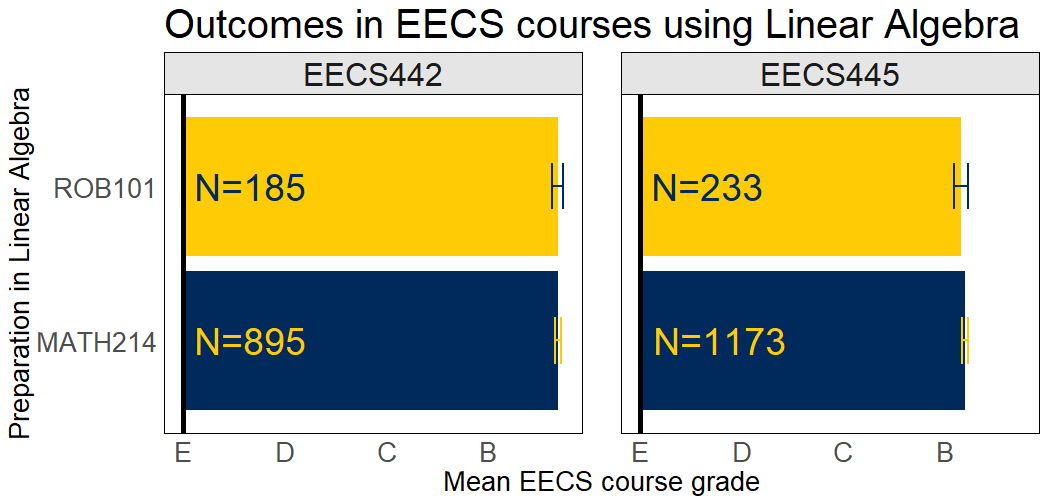
In EECS 442 Computer Vision and EECS 445 Machine Learning, grade outcomes for ROB 101 and MATH 214 students were statistically comparable.
- Equity
- One design goal was to provide a more equitable learning environment for students coming from less well-resourced high schools. Data from the first several terms show grade outcomes that are much more equitable than in many introductory STEM courses.
- Retention
- Overall College of Engineering retention rates, and retention rates for female students, were higher for students who took ROB 101 than for students who did not.
- Assessment
- Michigan Robotics, CRLT, and CRLT-Engin analyzed upper-level courses requiring linear algebra, comparing students who satisfied the prerequisite through ROB 101 with those who took MATH 214. The EEI Days 2026 session credits this work to a team that included Dr. Heather Rypkema, Head of Learning Analytics and Associate Director of the Foundational Course Initiative at CRLT.
The implication: students can move into advanced AI and robotics coursework earlier without losing preparation once they arrive, while the course also advances Michigan Robotics' equity goals.
For faculty and potential adopters
ROB 101 is open, scalable, and built around a complete ecosystem of textbook chapters, Julia labs, lecture notes, homework, programming assignments, projects, recorded lectures, and a tested large-course staffing model.
- Scale
- One instructor with a team of undergraduate teaching assistants can handle 250 students per semester.
- Access
- Algebra is the only prerequisite, and Julia can be used through browser-based course infrastructure rather than expensive software. For Fall 2026, the remote section is being paused while assessment is redesigned around controlled computer-based testing.
- Theory
- The course includes linear systems, LU, determinants, inverses, vector spaces, span, linear independence, bases, eigenvalues, eigenvectors, rank, the rank-nullity theorem, null spaces, Gram-Schmidt, QR, least squares, regression, root finding, gradient descent, Hessians, and classification foundations.
- Pathway
- ROB 101 is the undergraduate entry point for a mathematics sequence that can connect naturally to ROB 201 and ROB 501.
For communications
ROB 101 is the story of moving serious linear algebra earlier, making computation part of mathematics from day one, and letting students see robotics and AI as reachable fields in their first year.
Public message
Michigan Robotics teaches linear algebra through computation, data, robotics, and intelligent systems.
Why it matters
The course gives students an earlier, more motivating path into the mathematical language of robotics and AI.
Adoption angle
ROB 101 has already scaled to large enrollments while keeping course materials open and reusable.
Resources
Course materials and background for students, instructors, adopters, and communications teams.
Course GitHub
Lecture notes, homework, programming assignments, projects, labs, recitations, and evaluations.
Open repositoryVideo lectures
Recorded ROB 101 lecture and lab materials from Fall 2020 and Fall 2021.
Fall 2020 playlistFall 2021 materials
Teaching innovation recognition
CRLT summary of the Provost Teaching Innovation Prize work.
Read CRLT summaryEEI Days 2026 assessment
Session: 1670 BBB - Robotics 101: Assessing a discipline-specific linear algebra course.
Open session list