ROB 501: Mathematics for Robotics
ROB 501 | Mathematics for Robotics
Where proof becomes estimation, optimization, and robotic inference.
A graduate-level mathematics course for robotics engineers who need to move fluently between physical intuition, formal abstraction, probabilistic estimation, real analysis, and optimization.
Mathematics for reading, proving, and building research-grade robotics
ROB 501 is not another programming-forward course. It asks engineers to add a more analytical instrument to their toolkit: definitions, proof techniques, abstract vector spaces, inner products, convergence, probability, estimation, and optimization.
The course is especially useful for students preparing for graduate research in robotics, controls, perception, estimation, machine learning, optimization, planning, or any area where papers use a professional mathematical vocabulary. Students should expect formal mathematics from the beginning, with robotics motivation never far away.
Who should take it?
Robotics graduate students, advanced undergraduates, and researchers who want stronger mathematical fluency for estimation, analysis, and optimization.
What preparation helps?
Basic matrix algebra, probability, vector calculus, complex numbers, and MATLAB familiarity are assumed in the course repository.
What is different?
The course develops abstraction directly. Students do proof work from day one instead of meeting theory only after applications.
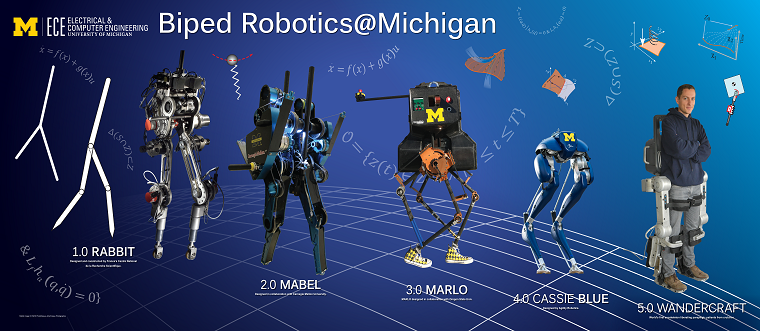
ROB 501 prepares students for the mathematical language behind modern robotics research.
Why these topics, and why this order?
ROB 501 was designed and piloted in 2014 after interviewing Robotics faculty about the mathematical preparation students needed for graduate robotics. The topic list was then refined while the lecture notes, homework, and exams were being built. The result is not a grab bag of advanced math; it is a staged path through the mathematical language students repeatedly encounter in robotics research.
The sequence is deliberately cumulative: proof habits support abstract linear algebra, abstract linear algebra supports least squares, least squares becomes estimation, and analysis gives students language for convergence and optimization.
Definitions first, then arguments
Students begin with proof methods including induction, fundamental theorem-style reasoning, and contradiction. The course makes formal reasoning part of the engineering workflow.
Abstract spaces, projections, and structure
Vector spaces, subspaces, bases, linear operators, eigenvalues, inner product spaces, projection theorem, Gram-Schmidt, QR factorization, symmetric matrices, and positive semidefinite matrices provide the backbone.
Least squares becomes uncertainty-aware inference
The course moves from normal equations and recursive least squares into BLUE, minimum variance estimation, probability spaces, random variables, Gaussian random vectors, and the Kalman filter.
Convergence, compactness, and optimization vocabulary
Normed spaces, open and closed sets, interiors, Cauchy sequences, continuous functions, compactness, Newton-Raphson, convexity, linear programs, and quadratic programs help students read and write mathematical robotics papers.
Evidence and downstream preparation
Over more than a decade of existence, ROB 501 has served as strong preparation for advanced robotics courses where uncertainty, estimation, mapping, perception, planning, and control all meet. Two especially natural next courses are ROB 530 and ROB 535.
Mobile Robotics: Methods and Algorithms
ROB 530 is listed in the Robotics course catalog as a Sensing course and in the Bulletin as theory and application of probabilistic techniques for autonomous mobile robotics, including Bayesian filtering, state estimation, mapping, localization, planning, and control under uncertainty. ROB 501 prepares students for the mathematical layer underneath those topics: probability, least squares, Gaussian random vectors, Kalman filtering, and optimization.
Read the Bulletin description
Explore the public ROB 530 site
Self Driving Cars: Perception and Control
ROB 535 is listed as an Acting and Sensing course. The Bulletin describes topics including deep learning, computer vision, sensor fusion, localization, trajectory optimization, obstacle avoidance, and vehicle dynamics. ROB 501 gives students a stronger foundation for reasoning about sensor models, uncertainty, estimation, convergence, and optimization in systems that must act from imperfect measurements.
Read the Bulletin description
View in the Robotics course list
Course role in the Michigan Robotics mathematics pathway
ROB 101 and ROB 201 help undergraduate students meet linear algebra and calculus through computation, modeling, and robotics applications. ROB 501 is the graduate continuation: less about early access, more about analytical maturity.
From computation to proof
Students who have seen matrices and optimization as tools now learn the definitions and proof structures that make those tools general.
From examples to spaces
Least squares is developed in general inner product spaces before returning to finite-dimensional estimation algorithms.
From measurements to inference
Probability and Gaussian random vectors give students the language needed for uncertainty, conditioning, BLUE, MVE, and Kalman filtering.
From algorithms to convergence
Real analysis and optimization help students distinguish what an algorithm does from why and when it converges.
For faculty and potential adopters
ROB 501 is not just a description of a course. The public michiganrobotics/rob501 repository is a working course site from the Fall 2018 offering, with the course plan, lecture notes, homework, recitations, exams, textbook materials, MATLAB materials, and 26 recorded lectures.
- Start here
- Open the ROB 501 course repository for the complete public course structure, including schedule, lecture notes, homework, exams, recitations, MATLAB materials, and textbook PDF.
- Textbook
- Open the ROB 501 textbook PDF, or use the textbook source repository for LaTeX source, chapters, handouts, and old exams.
- Recorded lectures
- Watch the Fall 2018 lecture playlist, which follows the repository schedule from proofs and abstract linear algebra through estimation, real analysis, and optimization.
- Scale
- The existing page notes that one instructor and one graduate teaching assistant can handle 100 students per semester, with one additional assistant recommended for each additional 50 students.
For communications
The short story is that ROB 501 gives robotics students the mathematical language of research: proof, abstraction, estimation, probability, convergence, and optimization.
Public message
Michigan Robotics teaches graduate mathematics as a research tool for estimation, inference, and optimization in robotics.
Why it matters
Robotics research often depends on knowing not only which algorithm works, but what assumptions and convergence arguments support it.
Pathway angle
ROB 501 completes the course-family story by extending ROB 101 and ROB 201 into graduate-level analytical preparation.
Resources
Course materials and background for students, instructors, adopters, and communications teams.
Course GitHub
Lecture notes, homework sets, exams, recitations, course schedule, MATLAB materials, and textbook PDF.
Open repositoryTextbook repository
LaTeX source files, chapters, handouts, and old exams for the ROB 501 textbook.
Open source repositoryLecture notes
PDF notes for proof, abstract linear algebra, estimation, probability, real analysis, and optimization topics.
Browse notes